
Russia’s strategic calculus: Renewed campaign of port attacks not expected after vessel strikes
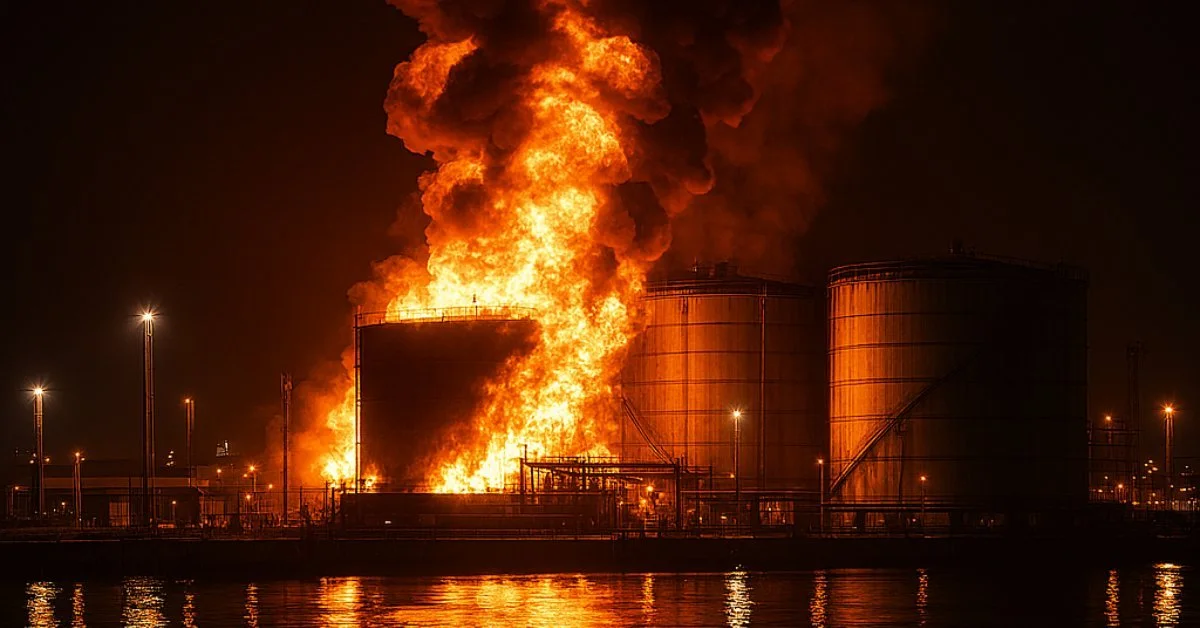
Illustration of a burning oil terminal reflecting the growing strategic impact of strikes on energy and critical infrastructure. AI-generated by CoPilot, created by Kristian Bischoff
15 December 2025
In late November and early December 2025, Ukraine successfully struck Russian vessels in the Black Sea, presenting Moscow with a strategic dilemma. While re-targeting Ukrainian ports remains an option, Russia has so far avoided committing significant energy to such operations. Instead, the Kremlin continues its established strategy of targeting Ukraine’s critical energy, transport, and heating infrastructure, aiming to make the winter months as difficult as possible for the civilian population.
By Kristian Bischoff - Analyst, Europe and Russia
Following Ukraine’s successful strikes on Russian vessels in the Black Sea in late November and early December 2025, Moscow faces a dilemma over how to respond. While one option would be to re-target Ukrainian ports and grain export facilities, Russia has so far avoided committing significant energy to such operations. Instead, the Kremlin has continued its established strategy of striking Ukraine’s critical energy, transport, and heating infrastructure, aiming to make the winter months as difficult as possible for the civilian population. This reflects the enduring Russian idea of having greater utility in maintaining pressure on Ukraine’s energy system.
The decision not to re-engage heavily against Ukrainian ports is shaped by several factors. Ukraine’s grain trade has proven resilient despite earlier Russian efforts to disrupt it. The Kremlin understands that targeting ports now offers diminishing returns. By diversifying export routes through Danube ports, rail corridors, and overland connections into the European Union, Kyiv has reduced its dependence on Black Sea terminals. This adaptation has blunted the strategic impact of port strikes, making them less attractive as a lever of coercion. As long as Russia is unable to maintain any semblance of control over the Black Sea and approaches to the Odesa ports – control which was lost in 2023 as Ukraine pushed back the Black Sea Fleet – Russia will not be able to significantly halt Ukrainian exports. At the same time, the international community has placed significant diplomatic weight behind ensuring Ukrainian grain reaches global markets. Renewed attacks on ports would therefore carry high political costs for Moscow, and would consume valuable missile and drone resources without delivering a decisive economic blow.
A further point is the relative efficiency of Ukrainian infrastructure strikes. Attacks on Russian ports and energy terminals have consistently proven more disruptive than the occasional high-profile strike on individual vessels. The latter, while symbolically powerful and useful as novelty signals of Ukraine’s reach, do not fundamentally alter Russia’s operational posture in the Black Sea. By contrast, targeting energy terminals has had a direct and measurable impact on Russia’s logistical chains and export capacity, undermining its ability to sustain the war effort. From this perspective, any Russian “retribution” for the attacks on vessels in late November and early December 2025 is strategically marginal. If Moscow was intent on recalibrating its campaign, the logical response would have come after Ukraine’s intensifying strikes on ports and terminals, where the damage was both systemic and enduring. While Russia has hit back against some vessels and ports following the dark-fleet vessel casualties, the relative effort is still very much focused on the strategy of eroding Ukrainian resilience via infrastructure strikes. This is evident in the number of drones and missiles hitting targets other than maritime ones in early December, which far outweighs what of port and vessel strikes.
Against this backdrop, Russia’s continued focus on Ukraine’s energy infrastructure is the maintenance of a status quo strategy, which is likely to continue. Strikes on power grids, heating plants, and utilities have long been central to Moscow’s approach, designed to deprive civilians of warmth and electricity during the harsh winter months. This campaign is operationally straightforward—fixed energy targets are easier to identify and strike than ineffective attacks on ports and mobile maritime assets—and psychologically potent. By freezing cities and disrupting industry, Russia hopes to sap morale, strain Kyiv’s governance capacity, force Ukraine into costly cycles of repair and recovery, and ultimately force negotiations and internal instability. The Kremlin’s calculation is that misery inflicted on the population yields more leverage than attempts to choke off grain exports that have already found alternative pathways.
In conclusion, Russia will still focus mainly on the established strategy of infrastructure strikes, although some signaling may occur in smaller attacks on ports and vessels. Moscow’s calculation of higher psychological payoff of energy infrastructure attacks, rather than limited effects on port and maritime strikes, point toward a winter campaign focused on freezing Ukraine into submission. For Kyiv and its partners, this underscores the urgent need to bolster energy resilience and accelerate repair capacity, as the Kremlin’s chosen battlefield this season lies not on the Black Sea but in the homes and streets of Ukraine’s cities.
MARITIME SECURITY REPORTS:
Our Risk Intelligence reports provide valuable insights to assess the risks of specific routes and support decision-making with detailed threat assessments.
The Voyage Risk Assessment focuses on a vessel’s specific route and offers an independent third-party perspective on the necessary security measures. The Monthly Intelligence Report delivers comprehensive analysis of recent incidents and a threat assessment for three key regions, available via subscription.
For maritime shipping operators with vessels in the Black Sea, please see our Northern Black Sea and Russia (Ports and Terminals) Weekly Intelligence Report here: