
Critical minerals at sea: China’s dual-use ports and influence on European supply chains
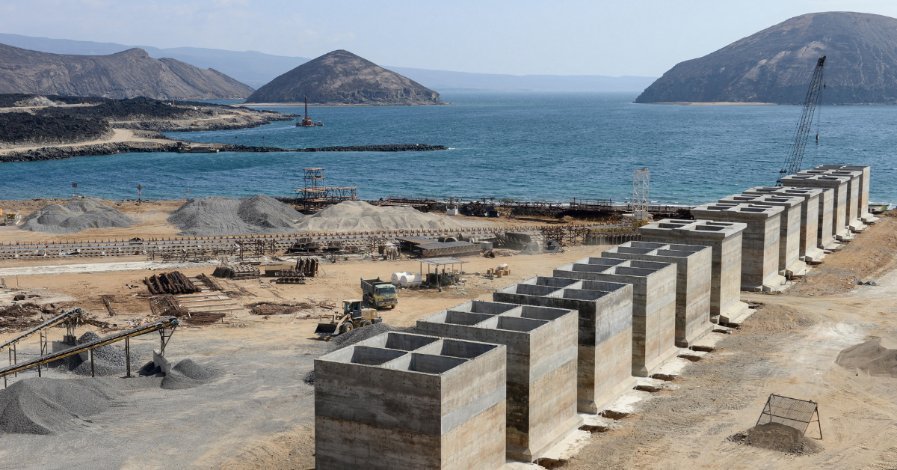
DJIBOUTI Lac Ghoubet, construction of new mineral port. Credit: Joerg Boethling, Alamy
08 December 2025
Europe’s clean energy transition and defence modernisation rely on secure maritime access to critical minerals, over 80% of which are traded by sea. Yet, Europe remains dependent on Chinese refining and is increasingly exposed to Beijing’s expanding overseas maritime footprint, including stakes in key dual-use port infrastructure and logistics networks. Chinese-linked facilities along major logistic hubs potentially facilitate enhanced visibility of, and leverage over, global mineral flows. As geopolitical tensions rise, this combination of processing dominance, strategic port access, and digital influence could undermine supply chain stability.
By Christina Jansson - Security Analyst Intern
China’s overseas ports lie along key maritime routes for critical minerals. Cobalt and copper from the DRC and Zambia transit the Bab el Mandeb, where Chinese-operated facilities in Djibouti control logistics. Integrated with the Chinese-financed Addis Ababa-Djibouti Railway and free-trade zones, these ports form corridors for mineral exports. Chinese-backed rail infrastructure elsewhere reinforces this network, including the Tanzania-Zambia railway, terminating at Dar es Salaam and is expected to transport up to three million metric tons of minerals annually. Similarly, lithium from Australia passes through the Strait of Malacca, a corridor where Chinese-linked ports and shipping networks play a growing role.
China’s international maritime presence has expanded over the past decade. Chinese state-owned firms hold stakes in at least 78 of Africa’s 231 ports, with influence also deepening across Europe. COSCO’s control of Greece’s Piraeus, a key Mediterranean port, illustrates how commercial investments shape regional trade networks. The port facilitates Chinese goods entering Europe and deepens Greece-China economic ties, while China’s state-owned shipping lines, infrastructure firms, and rail investments across Southeast Europe, combined with naval presence along the East China Sea-Eastern Mediterranean corridor, expand Beijing’s leverage. Minority stakes in Antwerp, Hamburg, and Bilbao similarly provide China with access to port logistics, operational planning, and real-time cargo data. Through terminal operators, who manage berth allocation, vessel prioritisation, and port call approvals, Chinese-linked entities can influence traffic patterns or prioritise certain vessels and cargo.
Many Chinese-built terminals are designed for dual-use operations, aligning with Beijing’s military-civil fusion strategy and its ambition to become a “strong maritime country”. Hence, commercial ports increasingly serve as platforms that can offer logistics and intelligence support to the People Liberation Army Navy (PLAN). Military relevant infrastructure, such as deep-water berths and heavy-lift cranes, can accommodate PLAN supply vessels, destroyers, and submarines. Several African ports with Chinese equity, including Dar es Salaam, Djibouti and Lagos, have hosted PLAN port calls and military exercises, reflecting this dual-use design. Visits include a flotilla to Lagos (2023), joint exercises near Durban (2023), and a frigate to Dar es Salaam (2024). At Djibouti’s Doraleh port, China’s joint development of a multipurpose port was swiftly followed by the opening of Beijing’s first overseas naval base in 2017. Beyond Africa, PLAN vessels have also docked at Port Klang, Malaysia, among other ports in the region.
China controls roughly 70% of critical mineral refining and 85% of rare earth processing capacity, with the 2025 export controls on mineral-based technologies demonstrating how Beijing could leverage this dominance strategically. Digital systems amplify these risks. China’s state-backed logistics platform maintains cooperation agreements with at least 24 foreign ports and operators, giving Beijing greater visibility over logistical supply chains, enabling operational optimisation by Chinese firms, and increasing dependence on its digital infrastructure. However, online networks remain vulnerable to cyberattacks, data manipulation and other digital disruptions, underscoring the strategic and operational risks of reliance on these port systems.
Europe’s exposure is twofold: dependence on Chinese mineral processing, and on ports where Beijing holds commercial, digital, or political leverage. Without stronger port cybersecurity, supply chain diversification under the EU Critical Raw Minerals Act, stricter oversight of foreign terminal operators, and enhanced maritime security at key chokepoints, Europe’s critical mineral lifelines remain vulnerable to disruption.
📢 INTELLIGENCE REPORTS:
Risk Intelligence reports deliver detailed, actionable insights, supporting decision-making and strengthening operational resilience.
Covering ports and terminals in Libya, the Northern Black Sea and Russia, the Middle East, regional updates across West Africa, the Western Indian Ocean, and Southeast Asia, as well as emerging threats like narcotics smuggling, our reports provide the intelligence you need to safeguard your operations. Whether you’re safeguarding your fleet, crew, or port operations, Risk Intelligence reports empower you to mitigate risks and respond proactively.