
Geopolitical tensions and threats impacting bulk carriers
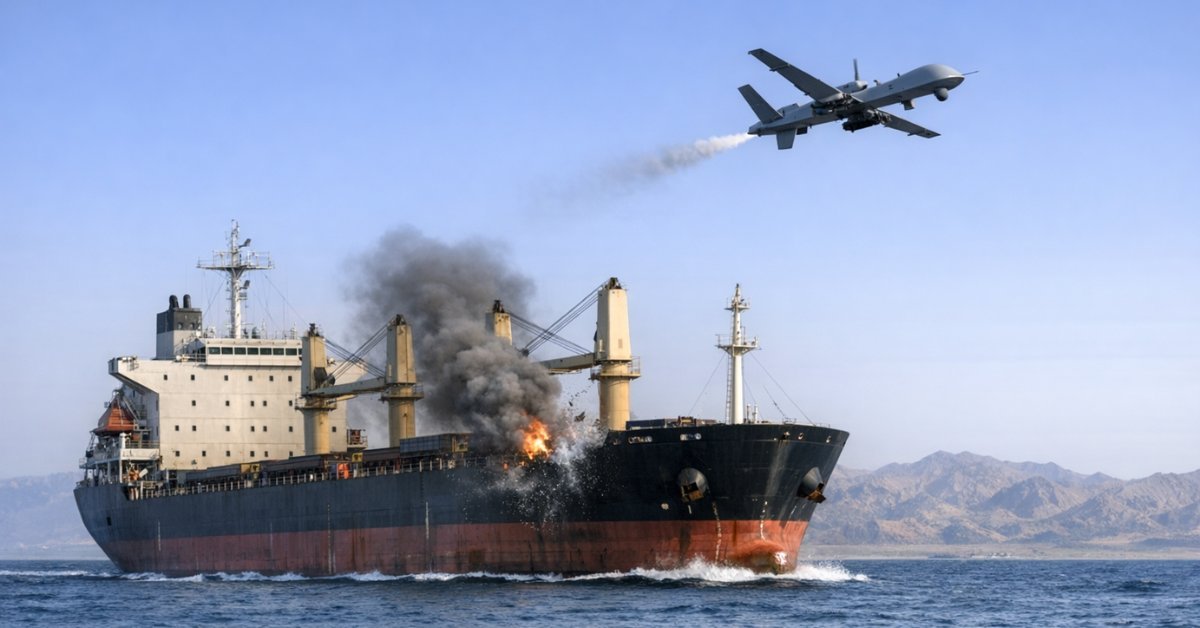
Illustration of a commercial vessel under drone attack, highlighting the growing strategic impact of threats to maritime trade. AI-generated by Copilot, created by Louis Borer
10 February 2026
Although very common in maritime trade, bulk carriers are particularly vulnerable during crises, as demonstrated by attacks in the Black Sea and the Red Sea. Their slowness, poor manoeuvrability and long stopover times make them more vulnerable to strikes, hijackings or pirate attacks. Although they are not major symbolic targets, unlike oil tankers or container ships, they remain popular for drug trafficking thanks to their many possible hiding places and the variety of ports they can serve. In short, even if they are not targeted for their nature, their physical and operational characteristics make them potential direct or collateral targets in areas where threats are high.
By Louis Borer, Senior Analyst
Bulk carriers are one of the most common types of ships in maritime trade. Their specific characteristics and vulnerabilities are rarely studied, compared to oil tankers and container ships, which symbolize energy dependence on the sea on one hand, and the maritimization of the global economy on the other hand. However, the current crises demonstrate the particular vulnerability of bulk carriers.
In the Black Sea, for example, several bulk carriers have suffered damage, including collateral damage from aerial attacks while docked. The time required to load and unload cargo, particularly Ukrainian wheat, often takes more than a week, further exposing ships to collateral damage when docked in ports that are likely to be targeted by Russian drones and missiles. This was the case for the MJ PINAR, which was hit by a missile in March 2025 while the ship was being loaded at its terminal in the port of Odessa.
Bulk carriers were also the ships most affected in the Red Sea during the Houthi campaign that began in November 2023. Here again, the ships were not targeted because of their type, but rather because of the Houthis' interpretation of their degree of alignment with Israel. However, depending on the type of trade flow, such as container ships, the latter reacted quickly, either by bypassing the Red Sea via the Cape of Good Hope, or by grouping together under the protection of naval escorts, which was less systematically the case for some bulk carriers. In addition, these ships are often slow and less suited to evasive manoeuvres, making them easier targets. The bulk carriers MAGIC SEAS and ETERNITY C, attacked by UAVs and USVs in July 2025, were the targets of the attacks most widely reported by Houthi propaganda.
Slow and low in the water, offering a low freeboard, these characteristics are particularly attractive for pirate groups in the Gulf of Aden/Somali Basin, and the Straits of Malacca and Singapore to board these ships. This is why most successful pirate attacks in the Indian Ocean since 2023 have mainly targeted bulk carriers, as was the case with the attacks on the RUEN, ABDULLAH, WAIMEA and LILA NORFOLK.
In addition, bulk carriers are highly prized by drug traffickers. Although most drugs are transported by container ships, bulk carriers are often used because they operate from terminals located in more remote areas with less stringent security measures. These ships also make one-off voyages, which affects the ability to profile the ships and their cargo. Bulk carriers are also used to transport drugs to destinations that are poorly served or far from major shipping routes, where the market value of cocaine guarantees a profit margin even for small quantities. On the other hand, unless the drugs are hidden in a compartment of the ship, often with the complicity of crew members, it is often more difficult to recover them. While it is easier to recover drugs from a container that has been tampered with during a Rip-On/Rip-Off operation, drug shipments hidden in large quantities of bulk cargo require lengthy and difficult investigations, which tie up the ship at the dock for longer periods of time.
In short, even if they are not targeted for their nature, their physical and operational characteristics make them potential direct or collateral targets in areas where threats are high. This is useful to keep in mind for risk assessment and mitigation.
📢 MARITIME SECURITY REPORTS:
Our Risk Intelligence reports provide valuable insights to assess the risks of specific routes and support decision-making with detailed threat assessments.
The Voyage Risk Assessment focuses on a vessel’s specific route and offers an independent third-party perspective on the necessary security measures. The Monthly Intelligence Report delivers comprehensive analysis of recent incidents and a threat assessment for three key regions, available via subscription.
For vessels operating in the Red Sea region, our Middle East Weekly Intelligence Report provides focused coverage of maritime security risks. For maritime shipping operators with vessels in the Black Sea, please see our Northern Black Sea and Russia (Ports and Terminals) Weekly Intelligence Report here: