
Europe’s land-based logistics in the grey zone: Vulnerability in an age of hybrid threats
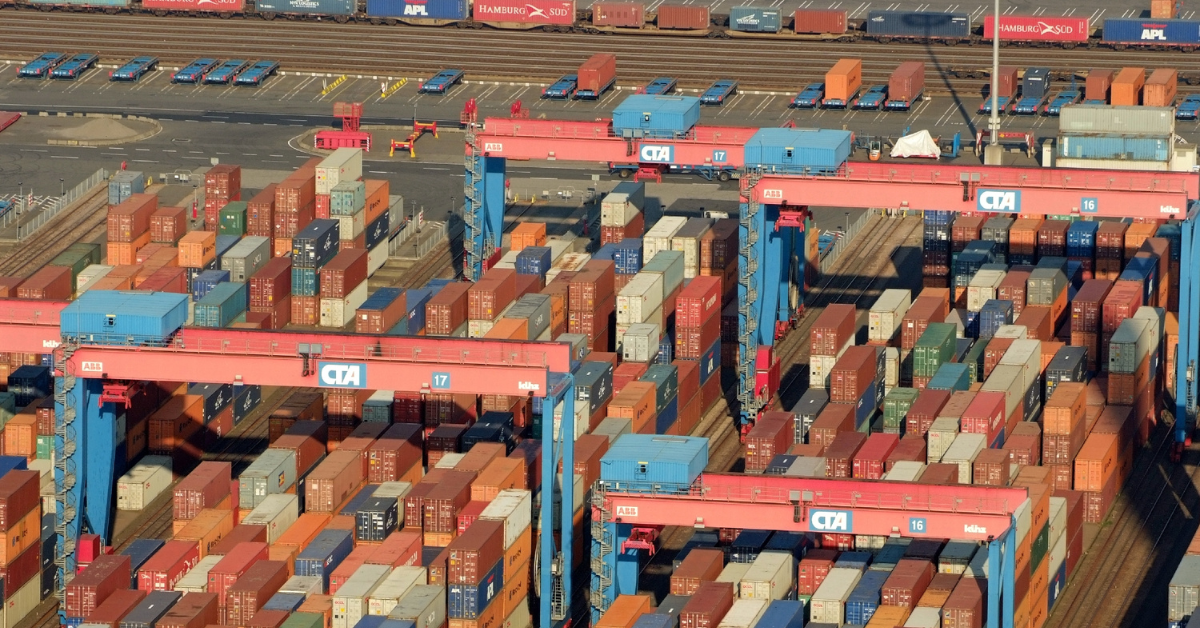
Illustration of stacked cargo containers at a freight terminal. Credit: Photo: Martina Nolte, Licence: CC BY-SA 3.0/de, via Wikimedia Commons
03 March 2026
Hybrid threats are redefining the vulnerability of European land-based logistics by exploiting their interconnected, dual-use nature below the threshold of open conflict, as even small-scale, ambiguous acts of disruption can produce disproportionate operational and psychological effects. This piece aims to shed light on how and why this evolution materialises, and to highlight that resilience, rapid recovery, and integrated coordination are vital for continuity in today’s landscape.
By Jeanne Albin - LandRisk Manager
Hybrid threats refer to a blended form of conflict that operates in the grey zone between war and peace. As much of today’s strategic literature suggests, these do not represent a complete break from traditional conflict, but rather an evolution in how power is applied. Pressure is exercised continuously, below the threshold of open conflict, by targeting and exploiting the structural vulnerabilities of open modern societies. Supply chain operations sit squarely within this landscape: as highly interconnected, cross-border systems underpinning both economic continuity and defence mobility, they combine strategic importance with inherent exposure. The question is thus not whether logistics networks are vulnerable, but how hybrid threats have altered the scale, persistence, and nature of their vulnerability.
Indeed, transport and logistics infrastructure have always been exposed to threats, including vandalism, terrorism, cargo theft, and other forms of criminal interference. What has changed in recent years is not their exposure to threat as such, but the context in which these vulnerabilities are understood and exploited. In an era of renewed geopolitical competition, logistics networks are increasingly seen as leverage points in interstate rivalry, as railway lines, road corridors, freight terminals, fuel depots, and intermodal hubs are recognised as dual-use systems essential for economic stability and mobility.
In this context, hybrid threats are reshaping the vulnerabilities of European supply chain networks across several dynamics. First, logistics infrastructure and operations face permanent exposure even outside open conflict. Actions such as arson at warehouses, sabotage of railway lines, damage to transformers supplying logistics platforms, or intrusions at strategic construction sites create uncertainty and test response capabilities.
Additionally, such acts do not need to be large-scale to be effective: obstructing operations at a freight terminal or disrupting traffic on busy rail lines sends a clear message that critical infrastructure is vulnerable, producing both psychological and operational effects.
Finally, attribution is often ambiguous. An arson attack or a theft of cables along a railway line, for example, could appear as an isolated incident, radical activism, or opportunistic crime, yet in a tense strategic environment, it may form part of a wider, orchestrated effort. This ambiguity complicates legal classification and political response, particularly as state actors increasingly intersect with criminal networks. Indeed, transnational criminal networks already operate within logistics ecosystems through cargo theft, smuggling, fuel fraud, and other illicit trades. In a hybrid context, this embedded presence can be exploited. And whilst direct coordination is difficult to prove in many cases, the convergence of interests (destabilisation on the one side, financial gain on the other) creates opportunities to obstruct operations or facilitate disruptive activity with plausible deniability.
For logistics operations, this implies a shift in approach: site security, cooperation with local authorities, route planning, and business continuity planning become central to performance. Resilience and fast post-incident recovery are now strategic. Looking ahead, in an international environment marked by transatlantic political realignments (particularly under the presidency of Donald Trump) and persistent rivalries between powers, any perception of weakening Western cohesion could encourage hybrid operations and tests on European soil. Visible, interconnected, and inherently exposed land-based logistic infrastructure will remain prime targets for symbolic acts of sabotage. Ultimately, hybrid threats risk redefining logistical vulnerability through gradual and targeted erosion. For industry actors, understanding this logic thus isn't just a security requirement: it is a condition for operational continuity in a persistently contested environment.
📢LandRisk Logistics:
Discover how LandRisk Logistics can assist in protecting your supply chain against evolving security threats
Contact us to learn about customised, intelligence-driven strategies designed to enhance resilience and safeguard your operations. Our team collaborates closely with clients to identify vulnerabilities and develop practical solutions tailored to their specific challenges. Proactive engagement is essential to mitigate risks and ensure continuity. Get in touch today to stay ahead of potential disruptions.