
Syria’s oil and gas opportunities: what are the maritime implications?
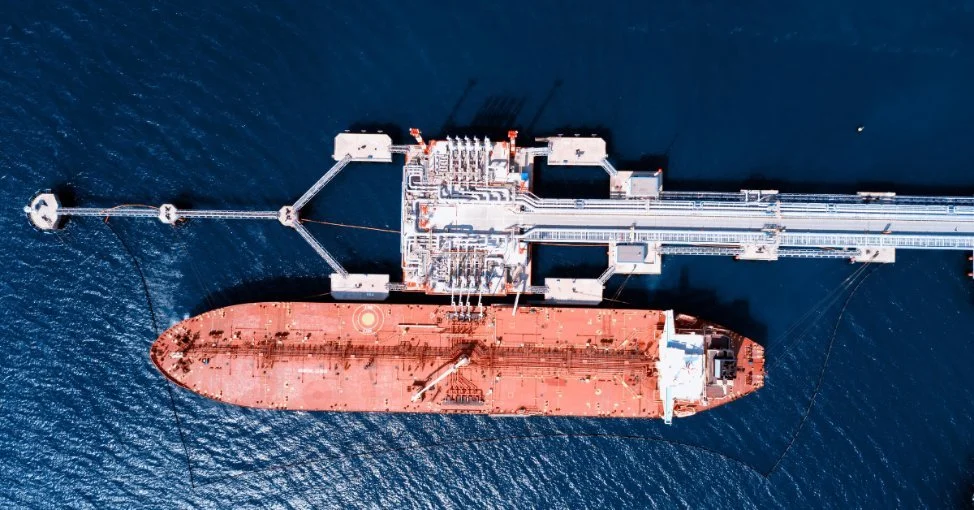
Oil tanker loading in port view from above. Credit: Pashkov Andrey, Alamy
9 October 2025
In its efforts to rebuild Syria is looking at the revival of its energy sector relying heavily on external support, as its damaged infrastructure requires massive investments to be rehabilitated and control over its oil and gas fields is still disputed. The country’s geostrategic position confers it an important role in linking the Asian and European oil and gas markets.
By Anas Mokdad, Security Analyst Intern
In post-Assad Syria, the government is facing challenges to rebuild the country and its economy. Years of conflict and civil war have created a structural energy deficit. The Syrian population has been experiencing massive electricity and fuel shortages. While the country has historically been a major producer and exporter of oil and gas, it is nowadays unable to resume the levels of activity that the industry saw prior to 2011. The infrastructure is in shambles and the continuing political tensions between the different factions are delaying the efforts to reinvigorate the energy sector.
One of the main strategies that the new government of Ahmed Al-Sharaa is relying on to cope with this crisis is to increase the import of gas, notably for electricity production and oil for fuel and related products. To do so, Syria has reached agreements with several countries, including Turkey and Russia.
With the fall of Bashar Al-Assad, Turkey is positioning itself as a key actor in Syria's efforts to increase its energy production, and potentially reviving its own oil and gas ambitions, which the ousted president opposed in favor of Iranian cooperation. In August, Azerbaijani natural gas started flowing through the rehabilitated Turkish-Syrian Kilis-Aleppo pipeline, as part of a multilateral project financed by Qatar. Azerbaijan will supply 1.2 billion cubic meters of natural gas annually through the Turkish pipelines, to boost power production in the regions of Aleppo and Homs with a targeted daily supply of 6 million cubic meters. This intake is currently increasing the daily electricity supply to Syrian households by 5 to 6 hours, although only raising it to a mere 10 hours of electricity per day.
On the maritime front, Syria has received discounted crude oil and fuel products from Russia, up to an estimated 12 million barrels of Arctic crude oil since the beginning of 2025, according to industry data. More than 7 tankers have been spotted at the Syrian oil terminal of Baniyas since March 2025, many of which are under international sanctions. These shipments came after the February declaration of the Syrian Ministry of Defense stating that Syria would retain Russian military bases of Tartus and Hmeimim if both parties reach an agreement that serves Syria’s interests.
The Baniyas refinery is the largest of the country and has been brought to a halt after Iranian oil supplies stopped with the fall of Assad's regime, which opened the way for other major players as the Baniyas refinery is unable to rely on the heavy and sour Syrian crude oil requiring specific configurations to be processed. Some revitalization in the sector can be illustrated by the first-in-14 years Syrian crude oil export shipment that left the port of Tartus in early September. The 640,000 barrels were split between the Sarroch Oil Terminal in Sardinia and the Marine Terminal of Trieste. The European refineries have typically relied on Syrian heavy crude oil, with an estimated $3 billion worth of oil imports from Syria in 2011.
After years of unrest, the complex state of Syrian affairs is evolving with growing momentum. This is leaving room for opportunities and Syria has the potential to become an important oil and gas player in the region, with a growing interest among foreign players in rebuilding its export industry.
RISK ASSESSMENT REPORTS:
Enhance your decision-making with Risk Intelligence's comprehensive risk assessment reports
Tailored to your needs, our reports offer in-depth analyses of threats for specific operations, regions, or routes. Whether it's the Voyage Risk Assessment for operational readiness or the Security Risk Assessment for strategic planning, our insights equip you with the knowledge to mitigate risks effectively.