
Military Mobility Northern Nordics: Transport Infrastructure and Capacity
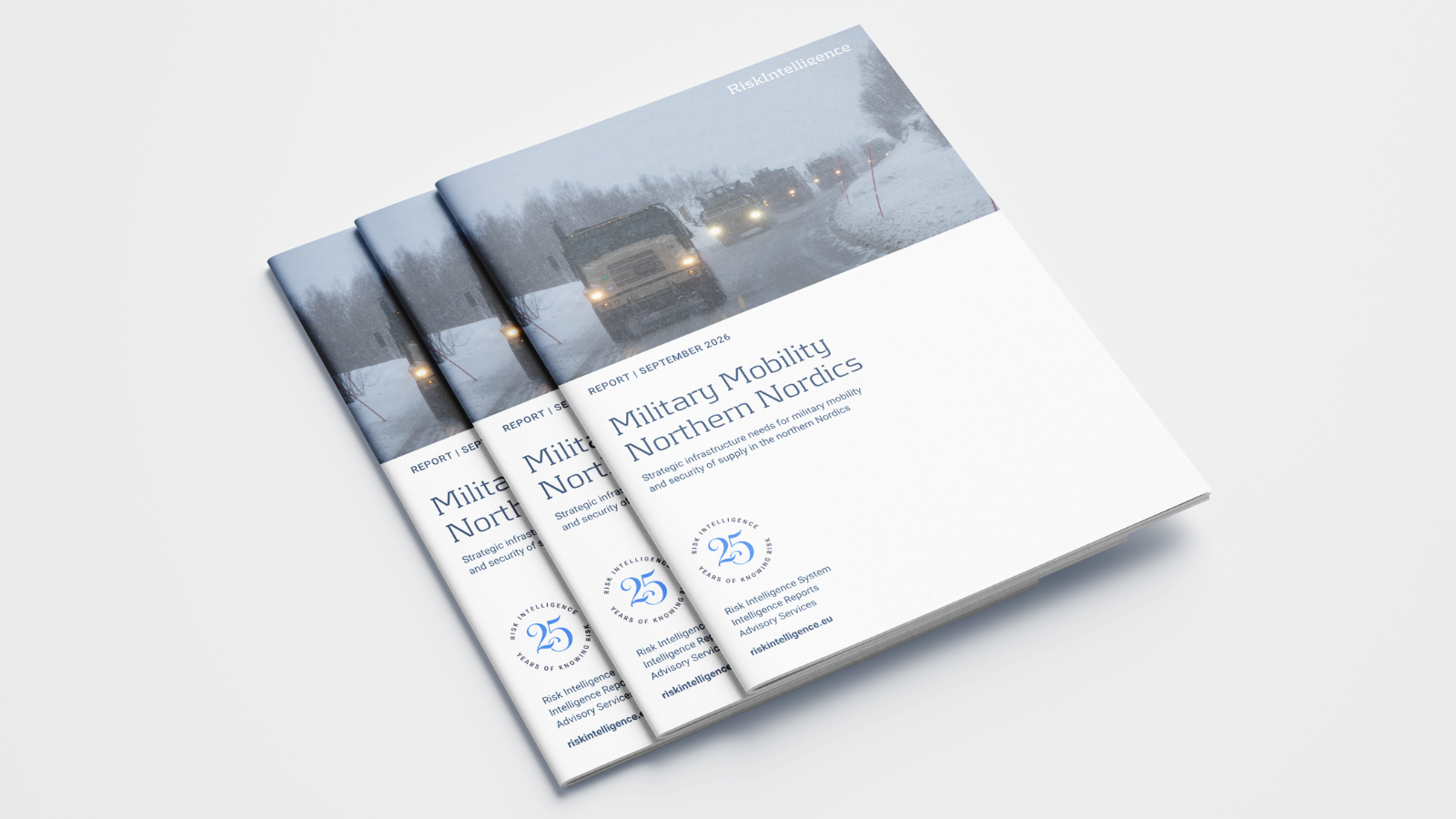
‘Military Mobility Northern Nordics’ report written by Risk Intelligence. Image: Risk Intelligence
29 September 2026
Commissioned jointly by Kvarken Council EGTC, MidtSkandia, and Fellesrådet for Trøndelag Jämtland Härjedalen, and supported in part by the EU-funded Interreg Aurora FLINC project, the report examines whether transport infrastructure across central Norway, Sweden, and Finland can meet future military mobility requirements while continuing to support civilian needs.
The Study Region covers the Kvarken region, including Central Finland, as well as Jämtland, Härjedalen, Västernorrland, Västerbotten, Trøndelag, and Helgeland. Its central location gives it significant strategic potential for transport across Norway, Sweden, and Finland. However, challenging geography, seasonal weather conditions and a limited number of alternative routes also create important constraints and vulnerabilities.
Using open-source information, the report develops several NATO mobilisation scenarios to assess potential transport requirements. These requirements are often underestimated: in a full-scale Article 5 scenario, more than 150,000 allied soldiers and around 39,000 vehicles could be deployed from outside the Nordics, alongside substantial supplies, equipment and forces mobilised by the three Nordic countries. The analysis also identifies bottlenecks where different modes of transport connect, particularly between ports, roads and railways, which can limit the practical capacity of the wider network.
Military and civilian transport would need to coexist during a crisis or conflict. The report therefore identifies a range of measures to strengthen transport capacity, from increased maintenance, improved connections between transport modes, stronger military-civilian cooperation and better information-sharing to larger, long-term infrastructure projects.
Read the report in full here: Kvarken Council
MILITARY MOBILITY & INFRASTRUCTURE:
Support decision-making with intelligence-led assessments of critical infrastructure and transport networks
Risk Intelligence supports organisations in understanding vulnerabilities across strategic transport corridors, critical infrastructure and supply networks. Our assessments can help identify bottlenecks, critical nodes and dependencies, evaluate route and corridor risks, and support planning for military mobility and security of supply.